
New Delhi (thestates.news)| Once a stubborn by-product of consumption, waste became an ever-growing challenge with rising populations and rapid urbanization. Answering the call of Prime Minister Narendra Modi through the Swachh Bharat Mission, India flipped the script—under the Ministry of Housing Urban Affair’s (MoHUA) leadership and SBM-U, waste is no longer a problem but a resource, transformed into products and revenue. Nowhere is this shift more evident than in coastal cities, where coconut waste—once a civic headache—has found a second life in the circular economy, turning nature’s leftovers into livelihoods and value.

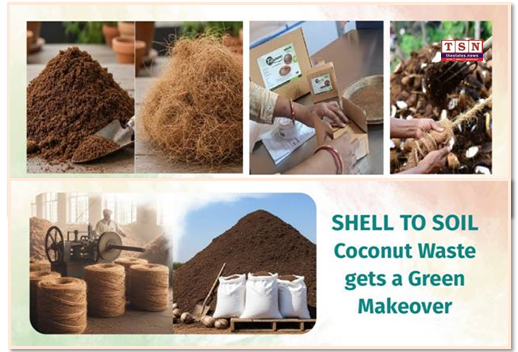
As tourists flock to coastal cities seeking clean, safe, and beautiful destinations, coconut water remains the drink of choice by the sea—healthy, refreshing, and hugely popular. That popularity once meant mountains of coconut waste heading to landfills. Not anymore. Today, coconut waste is segregated, recycled, and reborn as value—turned into cocopeat for organic manure and soil alternatives, and coir fibres spun into strong ropes. What was once a seaside problem is now a smart solution.
Coconut waste has transformed from mere “green waste” into a high-value resource. Official data shows coconut husk forms 3–5% of urban wet waste—small on paper, but massive when stacked against the 1.6 lakh tonnes of municipal waste generated daily, rising to 6–8% in coastal cities. With Karnataka, Tamil Nadu and Kerala leading production—and Karnataka now taking the top spot—India is proving that even a discarded shell can crack open big economic value.(s-pib)