
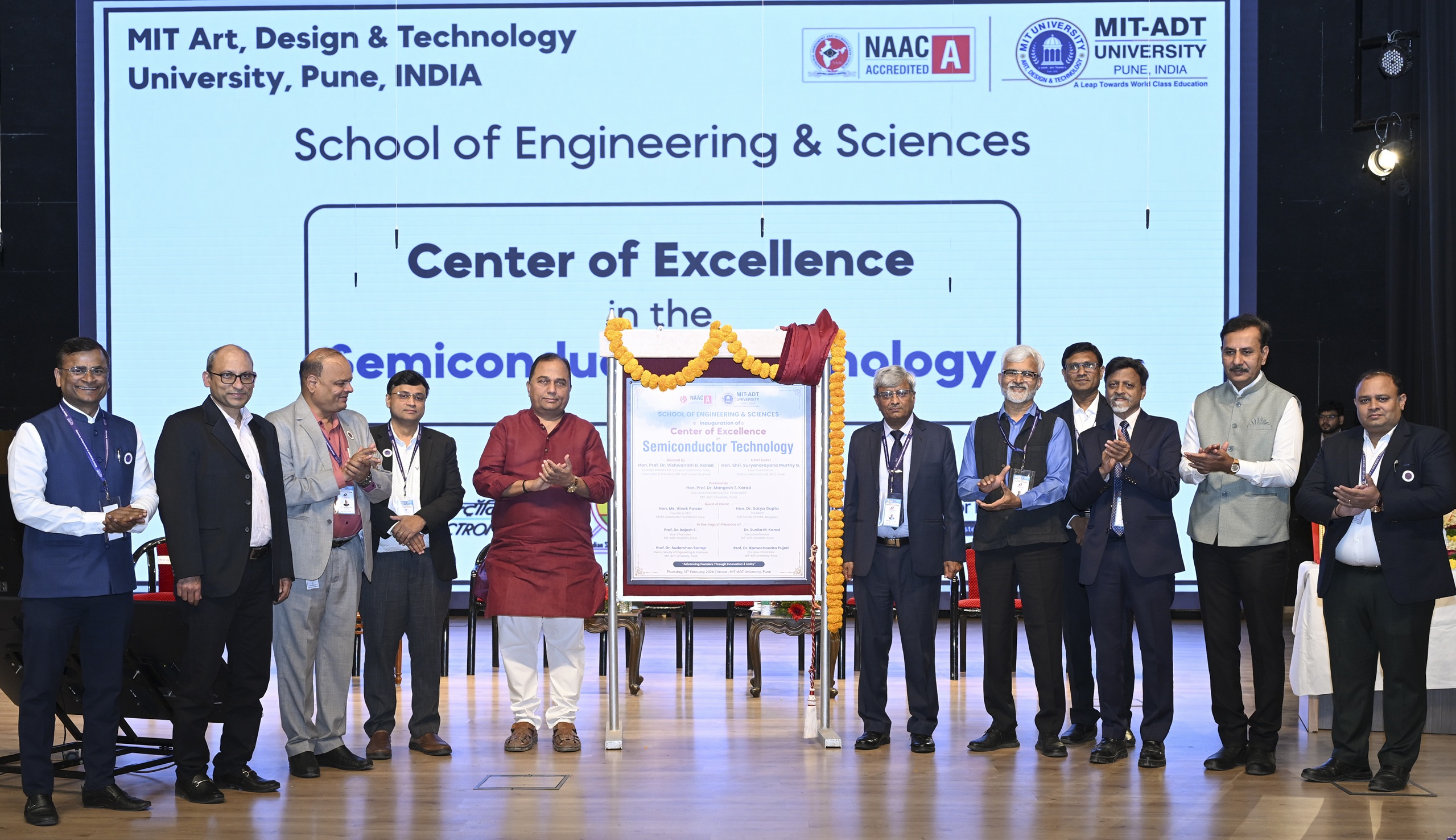
Pune (thestates.news) : With India importing nearly 94% of its semiconductor chips, the country remains heavily dependent on foreign nations for critical technology, said Prof Dr Mangesh Karad, Executive President and Pro-Vice Chancellor of MIT Art, Design and Technology University. He warned that any disruption in chip supplies from dominant global players could place India in a vulnerable position.
Speaking at a national seminar on “Semiconductor Technology” organised by the School of Engineering and Sciences at MIT ADT University, Dr Karad highlighted the Government of India’s Semiconductor Mission announced under the Prime Minister’s leadership. The mission has earmarked Rs 76,000 crore to promote semiconductor manufacturing in the country. “With projected investments likely to reach Rs 1.6 lakh crore, the sector is poised to generate substantial employment opportunities for students and young engineers,” he said.
The event also marked the inauguration of the Centre of Excellence (CoE) in Semiconductor Technology and the launch of the students’ Semiconductor Club (Semi-C). The programme was held at the Late Urmila Tai Karad Auditorium on the university campus.
Among the dignitaries present were Surya Narayana Murthy, Executive Director, Bharat Electronics Limited (BEL); Vivek Pawar, Founder and CEO, Netra Accelerator Foundation; Dr Satya Gupta, President, VLSI Society, Bengaluru; Vice-Chancellor Prof Dr Rajesh S; Pro-Vice-Chancellor Dr Ramchandra Pujeri; Dr Mohit Dubey; Dean Dr Sudarshan Sanap; Dr Virendra Shete; and programme coordinator Dr Ramesh Mali. Industry experts, researchers and students from across the country attended in large numbers.
Addressing the gathering, Murthy pointed out that India currently lacks the advanced fabrication infrastructure, process capabilities and skilled manpower required for large-scale semiconductor manufacturing. “Countries such as Japan, South Korea, Taiwan, the United States and China dominate the global semiconductor supply chain. Taiwan alone accounts for nearly 65% of global production,” he noted, adding that BEL, in collaboration with the government, is working to reduce India’s dependence on imports.
In his introductory remarks, Dr Pujeri outlined the university’s research-driven academic approach, while Vice-Chancellor Dr Rajesh S emphasised the institution’s commitment to nurturing globally competent engineers through advanced technology education and strong industry collaboration.
The programme commenced with a World Peace Prayer and concluded with the recitation of Pasaydan. Dr Sanap delivered the vote of thanks, and Prof Sneha Waghatkar anchored the session.
Pune Can Emerge as Next Semiconductor Hub: Vivek Pawar
Vivek Pawar observed that students currently show a strong inclination towards software engineering, but with the rapid rise of Artificial Intelligence (AI), there is an urgent need to refocus on core engineering domains. “Semiconductor technology represents India’s future. What we need now is a robust ecosystem to support manufacturing and innovation,” he said. He expressed confidence that with the right investments and infrastructure, Pune could emerge as a semiconductor hub after Bengaluru and Chennai, opening up significant employment avenues for the youth.