
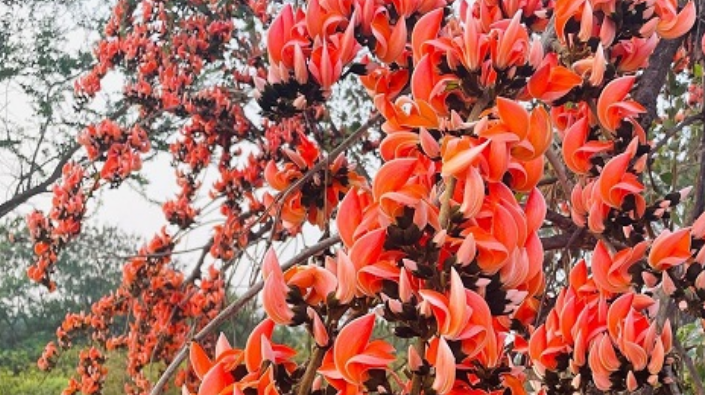
Raipur (thestates.news) | The vibrant blossoms of Palash (Tesu or Dhak) are no longer just a seasonal spectacle across rural landscapes, but a vital driver of livelihood, health, and economic resilience. Often referred to as the “Flame of the Forest” for its striking orange-red blooms, the Palash flower is increasingly becoming a cornerstone of rural prosperity in Chhattisgarh.
A Flower Rooted in Medicine and Culture
Botanically known as Butea monosperma, Palash holds immense medicinal and cultural significance in India. Its flowers, seeds, and gum (commonly known as Kamarkas) are widely used in Ayurveda for treating skin ailments, intestinal worms, diabetes, and enhancing reproductive health. Beyond healthcare, the flowers are used to produce natural Holi colours and in skin care formulations, offering an eco-friendly alternative to synthetic products.
In the Katghora Forest Division of Chhattisgarh, Palash trees are found in abundance across regions such as Pasan, Kendai, Jatga, Etmanagar, Katghora, Chautma, and Pali. For tribal and forest-dwelling communities here, the collection of minor forest produce remains a primary source of livelihood. Palash flowers are typically collected during March and April. In 2025, the Chhattisgarh State Minor Forest Produce Federation, Raipur, fixed the procurement rate at ₹11.50 per kilogram, ensuring fair compensation for collectors.
Rising Collection, Better Returns
The collection of Palash flowers in Katghora Forest Division has shown encouraging trends over the years. In 2022–23, a total of 402 quintals were collected by 116 collectors. This was followed by 58 quintals from 40 collectors in 2023–24, 147 quintals from 107 collectors in 2024–25, and 76 quintals from 20 collectors in 2025–26.
Alongside improved procurement systems, the market value of Palash has also witnessed a steady rise. From ₹900 per quintal in 2022–23, the rate increased to ₹1,150 per quintal in 2024–25. Subsequently, the Federation headquarters facilitated sales at ₹1,600 per quintal, translating into higher returns for collectors.