
M-PACS formation, digital services, storage and cooperative banking in focus
Fertiliser supply, multi-state cooperatives on agenda; Chhattisgarh to showcase achievements
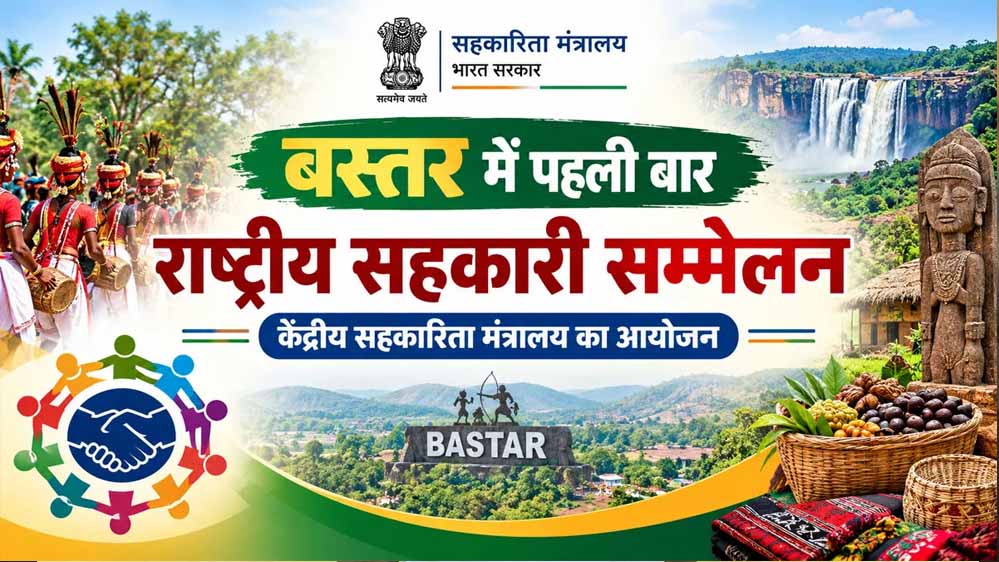
Raipur (thestates.news) |Bastar will host its first national cooperative conference in Jagdalpur on October 8 and 9. Organised by the Union Ministry of Cooperation, the conference will bring together senior officials from across India to chart an action plan under ‘Sahkar Se Samriddhi’, or prosperity through cooperation. The conference will be chaired by Shri Asish Kumar Bhutani, Secretary, Department of Cooperation, Government of India. Shri Pankaj Bansal, Additional Secretary and Managing Director of the National Cooperative Development Corporation (NCDC), and Shri Siddharth Jain, Additional Secretary, Government of India, will also participate.
Discussions will focus on forming Multipurpose Primary Agricultural Credit Societies (M-PACS) and dairy cooperatives, computerising M-PACS, promoting digital technology in the cooperative sector, expanding storage capacity and strengthening cooperative banking. Fertiliser distribution through M-PACS and coordination with multi-state cooperative institutions will also feature prominently. An action plan for the next three months will be drawn up.
Chhattisgarh cooperation secretary Dr C R Prasanna said secretaries from 15 states and registrars of cooperative societies from 14 states would participate. The conference will focus on strengthening the rural economy, farmers’ incomes and local employment through cooperatives.
On the first day, participants will review the ministry’s key initiatives. States will share experiences in forming M-PACS and dairy cooperatives, expanding membership, providing digital services and improving access to credit. Discussions will also cover the world’s largest decentralised grain storage scheme, business diversification and links between primary societies and national cooperative institutions dealing in exports, organic products and seeds.
On the second day, NABARD and NCDC will outline financial support and state-wise targets for the next five years.Participants will discuss the supply of fertilisers and other agricultural inputs through M-PACS and share successful district-level cooperative models. Officials will also visit M-PACS, minor forest produce cooperatives and tribal cooperative societies in Bastar.
New societies and digital services widen reach
Secretary Dr Prasanna said Chhattisgarh had formed 515 new M-PACS, 356 fisheries cooperatives, 364 dairy cooperatives, 153 minor forest produce cooperatives and 63 women’s multipurpose cooperative societies under ‘Sahkar Se Samriddhi’ campaign, 3.18 lakh new farmer accounts have been opened with district central cooperative banks. M-PACS have been converted into Common Service Centres, while micro-ATMs available at 2,058 M-PACS have handled transactions worth more than Rs 324 crore so far.
Warehouse construction expands storage capacity
Warehouses with a capacity of 200 metric tonnes each are being built for M-PACS across the state. Under the RIDF scheme of 2022, warehouses have been constructed at 725 M-PACS. In 2025, a plan was approved to build warehouses at another 100 M-PACS with dilapidated storage facilities or no warehouses, and construction agencies have been selected. Warehouses are also proposed for the 515 newly formed M-PACS.
Under the world’s largest decentralised grain storage scheme, 46 M-PACS in the state have been selected. Loans have been sanctioned for 20, nine have received AMI subsidies and construction has begun at six.
Links with national cooperative institutions
The state government has appointed NCCF as the procurement agency for 14 districts and NAFED for 15 districts. A total of 2,058 M-PACS have been registered with NCCF and 412 with NAFED. Meanwhile, 1,681 M-PACS have secured membership of the national cooperative export society, 1,633 of the national organic cooperative society and 1,746 of the Bharatiya Beej Sahakari Samiti.
Ethanol plants support value addition and employment
In Kondagaon, an ethanol plant with a capacity of 80 kilolitres per day (KLPD) is supporting the procurement of locally grown maize at the minimum support price and generating employment. At Bhoramdeo, an 80-KLPD plant operating under a public-private partnership model is providing a steady and growing source of income to the cooperative sugar factory. Work towards establishing three more ethanol plants in Pandariya, Ambikapur and Balod is under way. These plants are expected to promote value addition to agricultural produce, employment and local economic activity.
Drawing on these experiences, the conference will discuss the way forward for expanding the reach, services and business activities of cooperative societies.