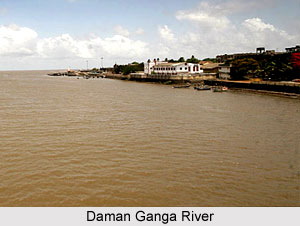
New Delhi (thestates.news) | As per the information provided by Gujarat Pollution Control Board, the technical corrective actions required for the improvement of quality of river Damanganga are under implementation. However, the order dated 28.08.2019 of Hon’ble NGT in the matter of M/s Vapi Green Envrio Ltd. & Ors. Vs. Aryavart Foundation has been stayed by Hon’ble Supreme Court.
Further, the following actions are taken for the industries operating against “polluter pays” and “precautionary measures” principles:
- The Gujarat Pollution Control Board (GPCB) is taking actions against the industries found violating environmental standards as per the provisions of Environmental Laws including closure directions and imposition of Environmental Damage Compensation (EDC) on defaulting industries to ensure accountability under the “polluter pays” principle.
- Further, to strengthen the compliance, GPCB regularly organizes Open House and Environmental Clinics to guide industries in adopting precautionary measures and sustainable practices.
- Seasonal Action Plans as precautionary measures:
- Winter Action Plan: Industries are directed to adopt stricter emission controls during winter months when atmospheric dispersion is lower, leading to higher pollution concentration. Measures include enhanced monitoring, dust suppression, restrictions on high-emission activities and ensuring maintenance of Air Pollution Control Devices.
- Monsoon Action Plan: Industries must ensure proper waste management and effluent treatment to prevent contamination of water bodies during heavy rains. GPCB issues letter to industries outlining preventive steps such as stormwater management, safe storage of chemicals and emergency preparedness.
Further, Central Pollution Control Board (CPCB), under Ministry of Environment Forest and Climate Change, has informed that it has not made Zero Liquid Discharge (ZLD) mandatory for all industrial units. In the Union Territory of Dadra & Nagar Haveli and Daman & Diu, industries generating trade effluent are required to install and operate Effluent Treatment Plants (ETPs). Further, such industries are mandated to achieve ZLD by reusing the treated effluent within their premises, as per the conditions stipulated by the Pollution Control Committee in the Consent to Establish/Operate.
Ministry of Jal Shakti has further informed that for conservation of rivers, the Ministry has been supplementing efforts of the States/UTs by providing financial and technical assistance for abatement of pollution in identified polluted stretches of rivers in the country through the Centrally Sponsored Scheme of National River Conservation Plan (NRCP) for other than rivers in Ganga basin and its tributaries. Assistance is provided to State Governments for abatement of pollution in identified stretches of various rivers (excluding river Ganga and its tributaries) under NRCP on cost sharing basis between the Central & State Governments. Under NRCP various pollution abatement works are taken up viz., interception & diversion of raw sewage, construction of sewerage systems, setting up of sewage treatment plants, low-cost sanitation, river front/bathing ghat development, etc. (s-pib)