
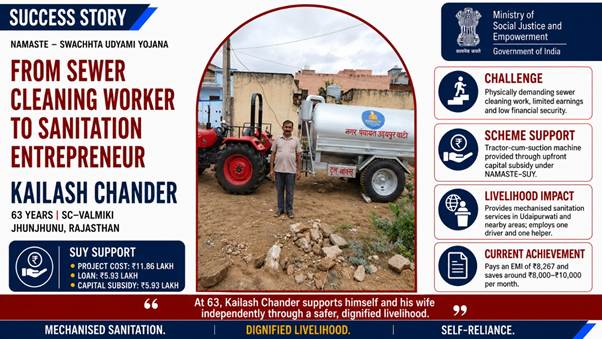
New Delhi(thestates.news) | For sanitation workers from socially and economically disadvantaged backgrounds, limited education, irregular earnings and dependence on physically demanding work can make financial security difficult to achieve. Timely support for mechanised sanitation services can open a pathway to safer work, self-employment and dignity.
Demonstrating the impact of the Swachhta Udyami Yojana (SUY) under the NAMASTE Scheme, Kailash Chander, a 63-year-old sanitation worker belonging to the Scheduled Caste-Valmiki community from Jhunjhunu district, Rajasthan, transitioned from physically demanding sewer cleaning work to operating his own mechanised sanitation-service enterprise.
A resident of Harijan Basti, Gudha Gorji, Kailash Chander studied up to the sixth standard and spent much of his life undertaking sanitation-related work to support his family. Limited livelihood opportunities and financial hardship compelled him to continue working as a sewer cleaning worker for many years, despite the occupational risks and modest earnings associated with the work.
His challenges became more pronounced with advancing age. The work remained physically strenuous, while low and unstable income, limited technical skills, social challenges linked to caste and occupation, and restricted access to sustainable livelihood opportunities made it difficult to build financial security.
Kailash Chander nevertheless remained committed to earning with dignity. Married and living with his wife, he has three sons who are married and reside separately with their families. He strongly believes in self-reliance and wanted to manage his own and his wife’s expenses without becoming financially dependent on his children.
A transformative opportunity came through the Swachhta Udyami Yojana, implemented under the NAMASTE Scheme. On 24 September 2025, he received financial assistance in the form of an upfront capital subsidy for purchasing a tractor fitted with a suction machine to undertake sanitation services independently.
The total project cost was ₹11.86 lakh, comprising a loan of ₹5.93 lakh and a capital subsidy of ₹5.93 lakh. This support enabled him to establish a mechanised sanitation-service business and move away from dependence on strenuous manual work.(s-pib)