
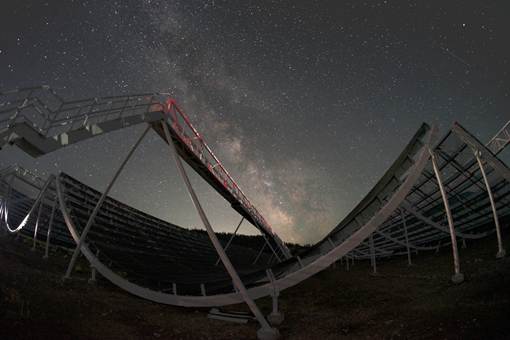
New Delhi (thestates.news) | In an international collaboration that includes researchers from India, the Canadian Hydrogen Intensity Mapping Experiment telescope (CHIME telescope) has made its first standalone detection of the glow of hydrogen from when the universe was about five billion years old, paving the way for new studies of cosmic expansion and dark energy.
The CHIME interferometric radio telescope in Canada was built to map the distribution of hydrogen gas in the early universe, allowing astronomers to calculate its expansion and thus investigate dark energy, the mysterious force thought to be driving the universe to expand faster over time.
In a study that included CHIME collaborators at the Raman Research Institute (RRI), an autonomous institute of the Department of Science and Technology (DST), the CHIME telescope has shown, for the first time, that it can detect the faint glow of hydrogen gas from deep in the universe’s past using only its own data.
The breakthrough paves the way for a faster, less expensive method for scientists to study dark energy — the mysterious force thought to be driving the universe to expand at an ever-increasing rate, and one of the biggest open questions in physics. The achievement also marks a milestone for the telescope, built for this very reason. The findings are published in a paper today in The Astrophysical Journal.(s-pib)